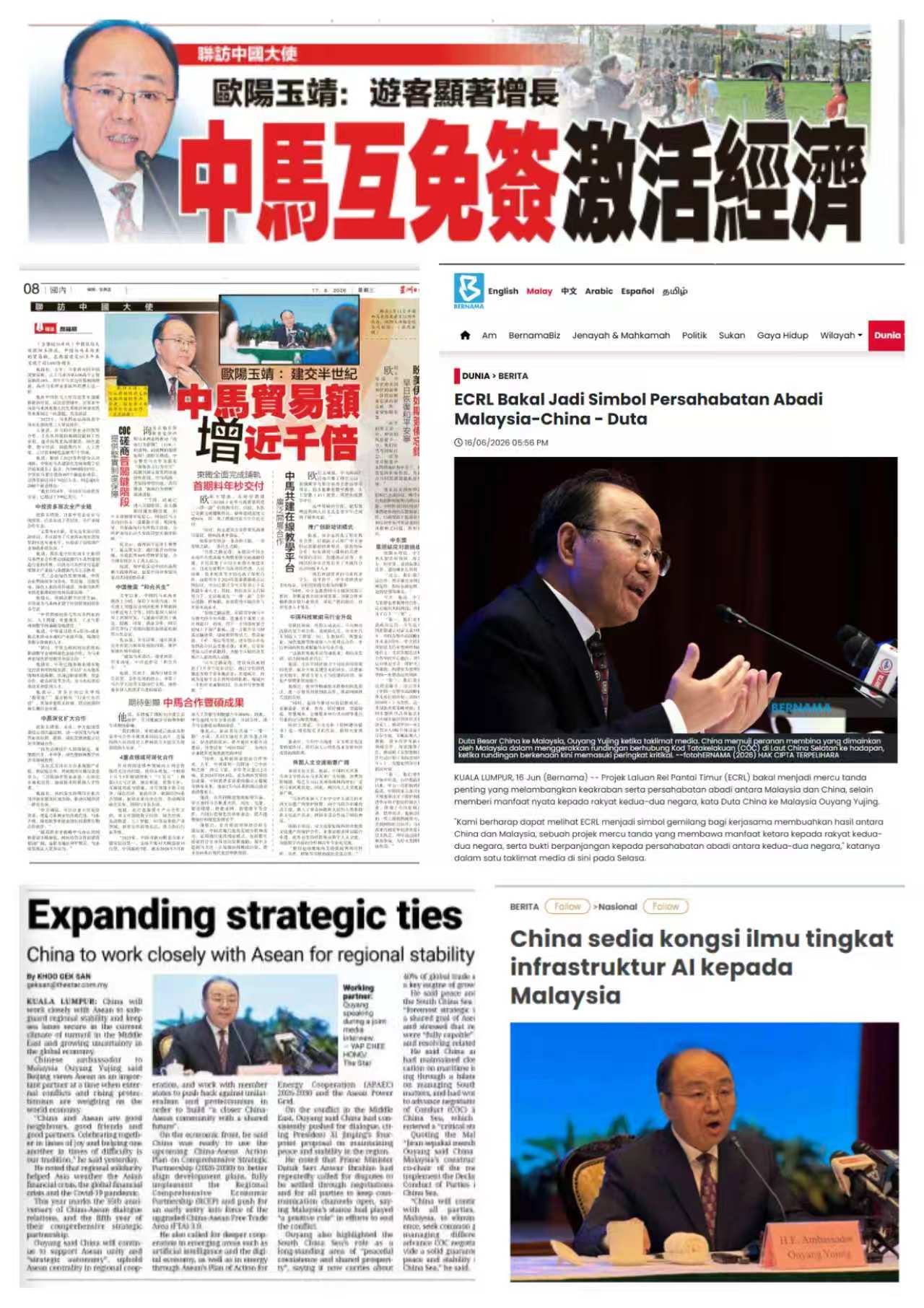
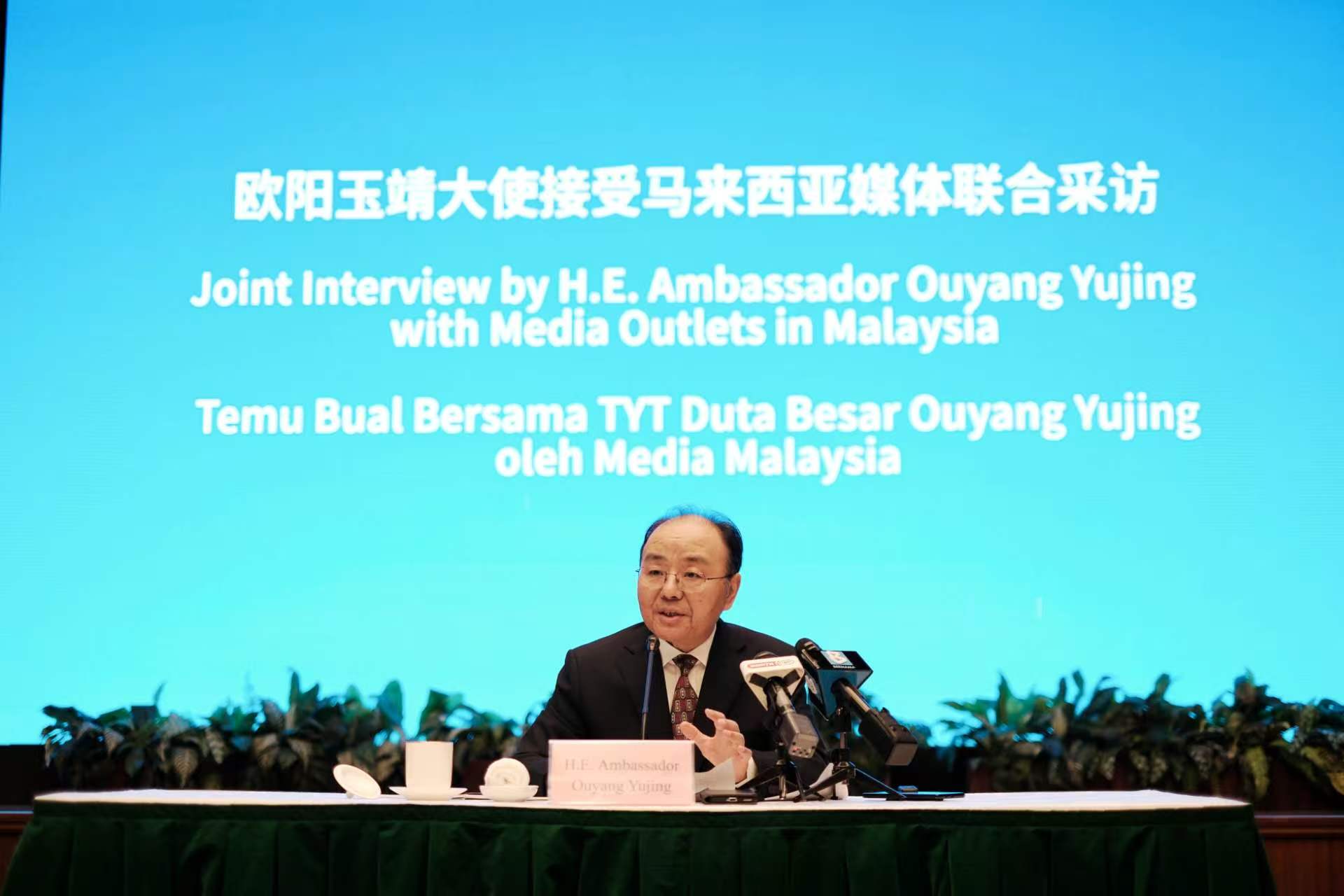
On June 16, on the occasion of the 52nd anniversary of China-Malaysia diplomatic relations, H.E. Ambassador Ouyang Yujing received a joint interview by Malaysian media outlets including Bernama, Radio Televisyen Malaysia, Sin Chew Daily, Nanyang Siang Pau, China Press, Oriental Daily News, Kwong Wah Yit Poh, Guang Ming Daily, The Star, New Straits Times, and Sinar Harian, and answered questions on Malaysia-China relations, China’s development as well as international and regional situation. The full text is as follows:
1.Q:Chinese President Xi Jinping paid a state visit to Malaysia last April, during which the leaders of both countries agreed to build a high-level strategic China-Malaysia community with a shared future. What are the unique advantages that have kept Malaysia-China relations at the forefront of the region for so long? What are the latest developments over the past year or so? Given the increasingly complex international situation, how should both sides continue to deepen the building of this community with a shared future?
A: In April last year, President Xi Jinping paid another state visit to Malaysia after 12 years. The two countries announced the establishment of a high-level strategic China–Malaysia community with a shared future, bringing our bilateral relations into the best period in history.
Over the past year, high-level exchanges between the two countries have reached a new record. Premier Li Qiang visited Malaysia twice, attending the ASEAN-China-GCC Summit and the Leaders’ Meetings on East Asian Cooperation. Prime Minister Anwar Ibrahim made his fourth visit to China during his term of office. Deputy Prime Ministers Ahmad Zahid Hamidi and Fadillah Yusof separately traveled to China for the opening ceremonies of the China-ASEAN Expo and the China International Import Expo respectively. These exchanges have further deepened and strengthened bilateral ties.
Over the past year, practical cooperation between the two countries has reached a new level. According to China’s statistics,bilateral trade in 2025 reached USD 191.66 billion, and China has remained Malaysia’s largest trading partner for 17 consecutive years. According to Malaysian statistics, China’s investment in Malaysia last year reached RM 58 billion. The East Coast Rail Link has reached 94% completion. The “Two Countries,Twin Parks” project has been upgraded and enhanced. Malaysia’s second 5G network, jointly built by Huawei and ZTE, is nearing completion. New areas of cooperation continue to emerge, with the benefits increasingly reaching the peoples of both countries.
Over the past year, people-to-people exchanges have achieved new breakthroughs. In 2025, the number of Chinese tourists visiting Malaysia exceeded 4.66 million, with the number of weekly flights reaching 716. Confucian–Islamic Civilization Dialogues were held in the capitals of both countries. A new pair of pandas in Malaysia made a successful debut. The animated film “Ne Zha 2” broke box-office records. Exchanges between the peoples of the two countries have continued to gain momentum, injecting fresh vitality into China–Malaysia relations.
These achievements are attributable to four major advantages of China–Malaysia relations.
We share deep historical ties. From the travels of the Buddhist monk Yijing to the voyages of Zheng He and his stay in Malacca, China–Malaysia friendship has been passed down for over a thousand years. Having withstood the tests of time, the two countries have accumulated many stories of friendly exchanges. This rich historical legacy has endowed China–Malaysia relations with strong resilience and provides valuable experience for continuously deepening bilateral friendship.
We enjoy strong political mutual trust. Since the establishment of diplomatic relations, China and Malaysia have consistently upheld strategic independence and respected each other’s development paths. On issues involving each other’s core interests and major concerns, the two sides have firmly supported each other, setting an example of mutual support and win-win cooperation between nations.
We have bright prospects for cooperation. China and Malaysia are at similar stages of development, and our economies are highly complementary. The two sides are working together to build a new hub for cooperation in developing new productive forces, while continuously strengthening integration across industrial and supply chains, value chains, data chains, and talent chains. The potential for cooperation will continue to expand.
We enjoy broad public support. The people of China and the people of Malaysia have long shared friendly feelings toward each other. According to the latest survey by Ipsos, 83% of Malaysians hold a positive view of China. Surveys conducted by Southeast Asian think tanks also show that support for China–Malaysia friendship among Malaysians has consistently exceeded two-thirds over the years. The strong foundation of friendship serves as a “stabilizer” for bilateral relations.
“Sharing blessings and standing together through hardships” is a common saying in both countries and it captures the essence of China–Malaysia relations. In a rapidly changing and increasingly complex international environment, we should work hand in hand to build a high-level strategic China–Malaysia community with a shared future, promote cooperation, safeguard peace, and share prosperity.
We should strengthen high-level exchanges, implement the important consensus reached by our leaders, enhance strategic communication, deepen exchanges on governance, and continuously improve mutual trust.
We should actively promote mutually beneficial cooperation, better align our development strategies, fully leverage our complementary advantages, tap the full potential of cooperation, and continuously improve the quality of China–Malaysia cooperation.
We should continue to consolidate people-to-people friendship, make full use of the visa-free arrangement and the opportunities presented by Visit Malaysia Year 2026, and expand cooperation in tourism, youth, education, culture, and sub-national exchanges, to increase both the depth and breadth of people-to-people engagement.
We should strengthen multilateral coordination, jointly uphold international fairness and justice as well as regional peace and stability, enhance cooperation within multilateral mechanisms such as APEC and ASEAN, build a closer community with a shared future for China and ASEAN, and continuously improve the well-being of people across the region. This year is China’s APEC host year. China is ready to seize this opportunity to work with all parties including Malaysia in building an Asia-Pacific community with a shared future.
I am confident that China–Malaysia relations are good today and will be even better tomorrow.
2.Q: The year 2026 marks the beginning of China’s 15th Five-Year Plan. What are the main directions and goals of China’s development over the next five years, and what impact will they have on world development?
A: In March this year, China’s two national sessions, the Fourth Session of the 14th National Committee of the Chinese People’s Political Consultative Conference (CPPCC), and the Fourth Session of the 14th National People’s Congress of China (NPC), successfully concluded. “Outline of the 15th Five-Year Plan (2026-2030) for National Economic and Social Development” was approved by the NPC during the session, providing a roadmap for China’s next five-year economic and social development, and sending an invitation to countries to jointly pursue modernization.
During the 15th Five-Year Plan period, China will actively advance the Chinese modernization. Meeting all the major targets of the 14th Five-Year Plan with GDP exceeding 140 trillion yuan, China is moving forward with new tasks set in the 15th Five-Year Plan, which are represented by 20 main indicators in the areas of economic development, innovation, people’s wellbeing, green and low carbon development, and security. China will focus on the important strategic tasks in 16 key sectors, and 109 major projects in various fields such as developing new quality productive forces, modernizing the infrastructure system, and ensuring and improving people’s wellbeing. China will work hard to achieve remarkable results in high-quality development, advance sci-tech self-reliance, deepen comprehensive reform, make cultural and ethical progress across society, improve people’s living standards, advance the Beautiful China initiative, and strengthen national security. Fulfillment of these tasks will make China well prepared for realizing its goal of becoming a moderately developed country in terms of GDP per capita, and basically achieving socialist modernization by 2035.
During the 15th Five-Year Plan period, China will resolutely practice high-level opening up. As the world’s largest trader in goods, China is the major trading partner of more than 160 countries and regions, and contributes roughly 30% to global economic growth every year. In the first quarter of this year, China’s import and export of goods exceeded 11.84 trillion yuan, rising 15% year on year, with the highest quarterly growth rate in the past five years. In the next five years, China will continue to give full play to the strengths of socialism with Chinese characteristics, and make full use of its unique advantages of the super-size market, comprehensive industrial sectors, and abundant human resources. China will continue to expand high-standard opening up, improve the level and quality of trade and investment cooperation, and achieve balanced development in import and export. China will continue to be the strong driver and stabilizer of global economy, not only tapping into the potential as the world’s factory, but also playing the role as the world’s market. Working with Malaysia and the rest of the world, China is ready to share opportunities and push forward the global modernization featured by peaceful development, win-win cooperation and common prosperity.
During the 15th Five-Year Plan period, China will contribute more to improving global governance. In a world full of uncertainties and turbulence, countries are more earnestly calling for fairness and justice, solidarity and cooperation, and peace and stability. Recently, Chinese Foreign Minister Wang Yi presided over a Security Council high-level meeting at the UN headquarters, and put forward five propositions, namely, to revitalize the UN Charter, the authority of the UN Security Council, the international cooperation on development, the platforms for global governance, and the efficacy of the UN system. China will continue doing more things for greater good, upholding multilateralism and pursuing greater solidarity to build a more just and equitable global governance system, and move towards the goal of building a community with a shared future for humanity.
To conclude, I hope all of you have known more about China’s 15th Five-Year Plan. The formulation and consistent implementation of five-year plans have been the important experience in China’s governance, and the advantage of socialism with Chinese characteristics under the leadership of the Communist Party of China (CPC). Since the founding of CPC 105 years ago, it has resolutely worked for the wellbeing of the Chinese people and progress of humanity, safeguarding the common interests of China and the whole world. Looking ahead, China will continue to advocate an equal and orderly multipolar world and universally beneficial and inclusive economic globalization, making efforts to implement the four Global Initiatives of Development, Security, Civilization, and Governance. China will continue to promote world peace and development, and defend the international order. Jointly, China is ready to work with all countries towards a brighter shared future.
3.Q:2026 marks the start of Malaysia's 13th Malaysia Plan and China's 15th Five-Year Plan. Looking ahead, what strategic priorities will be focused on to further strengthen the mutually beneficial cooperation between the two countries?
A: At present, both China and Malaysia are at critical stages of their respective development. China’s 15th Five-Year Plan and Malaysia’s 13th Malaysia Plan are aligned in vision and complementary in strengths. The two sides can further deepen coordination and empower each other, focusing on the four key areas of digital economy, green economy, blue economy, and tourism economy, to expand future economic cooperation and promote integrated, coordinated, and mutually beneficial development.
We can build a hub for cooperation on new quality productive forces. The two sides can cultivate new drivers of growth in high-value industries such as digital economy, green economy, advanced manufacturing, artificial intelligence, and 5G technologies, to support industrial upgrading in both countries.
China’s artificial intelligence has gained global recognition through its open-source approach, cost-effectiveness, and wide range of applications. In 2025, downloads of Chinese open-source AI models ranked first globally, and China accounts for 7 out of the world’s top 10 open-source AI models. As of March 2026, China’s AI patents account for 60% of the world. We are willing to share our experience and expand cooperation with Malaysia to help improve AI infrastructure and leverage AI to empower various industries.
We can advance high-quality Belt and Road cooperation. The two countries should continue to implement major projects such as the East Coast Rail Link (ECRL), promote rail-sea inter-modal transport, and enhance regional connectivity. The “Two Countries, Twin Parks” initiative should be further developed to provide a more favorable business environment for enterprises from both countries. At the same time, both sides should actively explore innovative forms of cooperation. Last year, the Zhengzhou–Kuala Lumpur “Air Silk Road” cargo route transported 20,000 tons of freight, 8.8 times the volume recorded in 2024, becoming an accelerator for bilateral trade. Tropical fruits favored by Chinese consumers, such as Musang King durians, can now reach Chinese consumers’dining tables within two days after harvest.
We can jointly promote energy transition. The global energy crisis triggered by turbulence in the Middle East once again highlights the importance of energy transition. China has the world’s largest and fastest-growing renewable energy system, as well as the most comprehensive renewable energy industrial chain. Clean energy now accounts for nearly 40% of China’s electricity generation. China’s production and sales of new-energy vehicles have ranked first globally for eleven consecutive years. China supplies more than 80% of the world’s photovoltaic components and 70% of its wind power equipment, providing a solid foundation for addressing global energy shocks. We are willing to work with Malaysia in areas such as solar and wind power, hydrogen energy, advanced energy storage, smart grids, and new energy vehicles, to jointly foster new forms of green economic development and enhance both energy resilience and sustainable development.
We can promote mutual learning on national governance. The fruits of modernization should benefit all people and enable common citizens to live a better life. This is an integral part of building a high-level China–Malaysia community with a shared future. It also reflects the aspirations expressed by distinguished participants from various sectors of both countries at the recent China-Malaysia Readers Forum on the English Edition of Xi Jinping: The Governance of China (Volume V).
Under the leadership of the CPC, the PRC has continuously explored and advanced its development path through nation-building and reform efforts, blazing a trail of socialism with Chinese characteristics and achieving remarkable accomplishments. The successful practice of Chinese modernization demonstrates that there is no single fixed model for modernization. Every country can explore a development path suited to its own national conditions. China stands ready to further strengthen exchanges and mutual learning with Malaysia on national governance, and to work together toward a new historical stage in our respective modernization journeys, which build on our past success for a better future.
4.Q:The United States and Iran have announced that they have reached an agreement, but the impact of the Middle East crisis is unlikely to disappear in the short term, and uncertainties in the global economy are still increasing. Against this backdrop, how will China cooperate with ASEAN countries, including Malaysia, to ensure maritime security and address the spillover effects of conflicts in the Middle East?
A: China and ASEAN are good neighbors, good friends, and good partners. Celebrating together in times of joy and helping one another in times of difficulty is our tradition. History has shown that unity is strength and cooperation leads to mutual benefit. In the past, through solidarity and cooperation, we overcame challenges such as the Asian financial crisis, the global financial crisis, and the COVID-19 pandemic. Today, we must continue to rely on unity and cooperation to address new common challenges.
We must strengthen political mutual trust. This year marks the 35th anniversary of the China-ASEAN Dialogue Relations and the 5th anniversary of the China-ASEAN Comprehensive Strategic Partnership. China will continue to firmly support ASEAN unity and strategic autonomy, support ASEAN centrality in regional cooperation, work together to address challenges posed by unilateralism and protectionism, and work with ASEAN countries to build a closer China-ASEAN community with a shared future.
We must deepen the integration of interests. Taking the implementation of the China-ASEAN Action Plan on Comprehensive Strategic Partnership (2026-2030) as an opportunity, we should further strengthen the alignment of development strategies. China is willing to work with ASEAN partners to implement the Regional Comprehensive Economic Partnership (RCEP) with high quality and work for an early entry into force of the China-ASEAN FTA 3.0. We need to expand cooperation in emerging areas such as AI and digital economy, deepen energy cooperation, and advance the alignment with regional initiatives such as the ASEAN Plan of Action for Energy Cooperation (APAEC) 2026-2030 and ASEAN Power Grid.
We must safeguard a peaceful environment. Since the fighting began, China has consistently promoted peace talks. President Xi Jinping has put forward a four-point proposition on maintaining and advancing peace and stability in the Middle East, reflecting China’s consistent position and active efforts in promoting peace, encouraging dialogue, and bridging differences, which has been widely recognized by the international community. Prime Minister Anwar has also spoken repeatedly up for justice, calling for disputes to be resolved through negotiation and for all relevant parties to maintain communication and coordination, which has played a positive role in bringing an end to the conflict.
China welcomes the agreement reached by the United States and Iran on the content of a first-phase memorandum of understanding, and hopes that it can be signed as scheduled. Every additional effort for peace reduces the risk of conflict. Together with the international community, we should continue to play a constructive role in restoring peace and stability in the Middle East and the Gulf region at an early date, to create a favorable environment for the common development of all parties.
As a Malaysian proverb says, “Bukit sama didaki, lurah sama dituruni”. As long as we work hand in hand, we will be able to pool the strength of cooperation, overcome the various challenges on the road ahead, and create a better tomorrow for the people of all countries in the region.
5.Q:In recent years, China has consistently been Malaysia’s largest trading partner and one of its most important sources of investment. Could you please provide details on the scale of Chinese companies’ investment in Malaysia, their major projects, and their economic contribution? Furthermore, how will China further deepen cooperation with Malaysia in areas such as trade, investment, technology transfer, and talent development in the future?
A:From the perspective of economic and trade relations, China has in recent years remained Malaysia’s largest trading partner and one of its most important sources of foreign investment. Over the more than 50 years since the establishment of diplomatic relations, bilateral trade has grown nearly 1,000-fold. In 2025, Malaysia continues to be China’s second largest reading partner in ASEAN. According to data from Malaysia, trade with China accounted for 18% of Malaysia’s total trade volume of RM3.06 trillion last year, and the growth rate of our bilateral trade is almost twice as much as the overall trade growth rate of Malaysia.
Chinese investment and business cooperation in Malaysia have gradually expanded beyond traditional infrastructure and engineering contracting into emerging sectors such as high-end manufacturing, green energy, the digital economy, new energy vehicles (NEVs), artificial intelligence, cloud computing, and green finance. According to the 2025 Report on Building a Community with a Shared Future: Achievements of Chinese Enterprises in Promoting Green Development and the Digital Economy in Malaysia, Chinese enterprises invested in 497 manufacturing projects in Malaysia between 1980 and 2023, with cumulative investments totaling RM74.2 billion and creating more than 82,000 jobs. By 2024, China’s accumulated investment stock in Malaysia had exceeded USD19 billion.
To date, Chinese investment in Malaysia has developed into a multi-layered and full industrial-chain cooperation ecosystem.
First, the East Coast Rail Link project has not only improved connectivity between the east and west coasts of Malaysia, but also stimulated industrial development and employment opportunities along the route.
Second, cooperation between China’s NEV companies and the Malaysian side has helped upgrade Malaysia’s NEV and smart manufacturing industries, while contributing to the development of a comprehensive NEV industrial ecosystem and building NEV ecosystems in Malaysia.
Third, in the field of green development, Chinese companies are actively participating in hydropower, solar energy, waste-to-energy, and green industrial projects, supporting Malaysia’s energy transition and low-carbon development.
Fourth, in the digital economy sector, Chinese enterprises have become important participants in Malaysia’s digital transformation. Chinese companies are actively involved in the development of 5G, artificial intelligence, smart cities, industrial internet, and digital infrastructure in Malaysia. Chinese enterprises are promoting the upgrading of local industrial chains and helping cultivate digital economy talent through a “technology + training + employment” model. At the same time, Chinese financial institutions are actively promoting cooperation in green finance and digital finance, providing financing support for Malaysia’s green transformation.
It is also worth noting that Chinese enterprises are placing increasing emphasis on localization and sustainable development. In addition to expanding local procurement and local hiring, many companies are cultivating technical and management talent in Malaysia through vocational training, university-industry partnerships, and joint research and development initiatives. Many enterprises are gradually shifting from simply “investing and building factories” to “jointly building industrial ecosystems”, with greater emphasis on technology transfer, supply chain collaboration, and long-term social contributions.
Looking ahead, China is willing to continue to uphold the principle of mutual benefit and win-win cooperation, and further deepen collaboration with Malaysia in trade, investment, green development, and the digital economy. First, China will continue to expand investment in areas such as high-end manufacturing, new energy vehicles, semiconductors, green energy, and the digital economy. Second, China will support enterprises from both countries in strengthening industrial and supply chain cooperation to jointly enhance regional industrial competitiveness. Third, Chinese enterprises will be encouraged to further deepen localization efforts, while strengthening technology transfer and talent development. Fourth, China will support enterprises from both countries in jointly exploring ASEAN and broader regional markets, thereby promoting regional economic integration.
China believes that Chinese enterprises are not only investors, but also long-term partners in Malaysia’s economic modernization, industrial upgrading, green transformation, and employment growth. As the high-level strategic China-Malaysia community with a shared future continues to deepen, bilateral economic and trade cooperation will enjoy even broader prospects and inject greater momentum into regional peace, prosperity, and sustainable development.
6. Q:Could you provide more details on the progress of the Malaysia-China cooperation project of ECRL? Once completed, how will this project promote regional connectivity?
A: The East Coast Rail Link (ECRL) is a flagship project of high-quality Belt and Road cooperation between China and Malaysia. The track-laying has been completed, with overall construction progress reaching 94%. Phase I is expected to be delivered by the end of the year. The delivery will mark a transition in our cooperation from high-quality construction to high-standard operation.
This is a road of cooperation. The ECRL is the largest single transport infrastructure project currently being built overseas by Chinese enterprises. It not only showcases the strong infrastructure capabilities of Chinese companies, but also demonstrates the depth of China–Malaysia cooperation in project management, workforce training, technical standards, and other fields. In 2024, the two sides signed a joint railway operations and maintenance agreement. To date, China has helped train more than 1,000 Malaysian railway professionals. With the joint efforts of both sides, the project is expected to become a model and benchmark for Belt and Road cooperation, significantly enhancing regional cooperation and connectivity.
This is a road of development. The ECRL traverses the Titiwangsa Range, the largest mountain range in Peninsular Malaysia, and connects a number of major industrial parks, ports, and airports. Going forward, it will further integrate industrial and supply chains along the route, improve logistics efficiency nationwide, enhance Malaysia’s attractiveness to investors, and support the growth of tourism, mining, shipping, and other related industries. It will also help narrow the development gap between the east and west coasts of the peninsula. Looking ahead, the project has the potential to connect with the broader Pan-Asian Railway Network, injecting new momentum into regional economic growth.
This is a road of livelihood and prosperity. During the construction phase alone, the project has created more than 20,000 jobs and benefited thousands of local Malaysian businesses through subcontracting arrangements. Once completed, it will serve as a land bridge linking the east and west coasts of Peninsular Malaysia, reducing travel time by approximately half and making transportation more convenient for local communities. Throughout construction, the project has placed great emphasis on environmental protection, minimizing impacts on vegetation and wildlife wherever possible and putting the principles of sustainable development into practice.
We look forward to seeing the ECRL become a shining symbol of the fruitful cooperation between China and Malaysia, a landmark project that delivers tangible benefits to the peoples of both countries, and a lasting testament to the enduring friendship between our two nations.
7.Q:In terms of people-to-people exchanges, which areas have the greatest potential for growth between Malaysia and China? How can we further enhance friendship between the two peoples through cultural, educational and scientific programs? How does China plan to further strengthen tourism cooperation with Malaysia?
A: China and Malaysia are geographically close and enjoy strong people-to-people ties. Our exchanges have a deep-rooted foundation. Culture, education, science and technology, and tourism are important components of our exchanges. They represent an important direction for further strengthening the friendship between the two peoples.
In the cultural sphere, Chinese classics such as the “Four Great Classical Novels” have been widely known in Malaysia. Contemporary Chinese literary works are also increasingly popular among Malaysian readers. Chinese films, television productions and audiovisual works continue to gain popularity in Malaysia. Malaysia has joined the Alliance for Cultural Heritage in Asia proposed by China. The “Wangchuan Ceremony”, jointly submitted by China and Malaysia, was successfully inscribed on the UNESCO List of the Intangible Cultural Heritage, becoming a model of cooperation on intangible cultural heritage for the world.
Going forward, both countries should further leverage culture as a bridge to connect hearts and minds, and promote exchanges and cooperation through a wider range of channels and forms. The Chinese film Dear You, which is about to be screened in Malaysia, is one such meaningful and touching production that is well worth watching.
We should also strengthen cooperation in safeguarding intangible cultural heritage and pursue more joint heritage applications. At the same time, we should actively expand new frontiers of digital cultural exchanges, strengthen cooperation on digital content and youth creativity, and continue to support exchanges and cooperation among think tanks, scholars, and media organizations.
In the field of education, China and Malaysia have carried out extensive cooperation through teacher and student exchanges, short-term study programs, joint training, and collaborative education. The two countries have steadily advanced cooperation in emerging areas such as digital education, AI education, and online learning platforms, thereby enhancing mutual understanding and friendship, especially among young people.
At the same time, both sides have deepened cooperation in vocational education and pioneered the “Chinese Language + Vocational Skills” training model. Through school-enterprise collaboration, joint curriculum development, teacher training, and skills certification, a large number of versatile technical professionals have been cultivated to support practical cooperation between the two countries.
Looking ahead, we should continue to promote high-quality educational cooperation and scale up institutionalized exchange, study, and joint training programs. China welcomes more Malaysian students to pursue studies in China and will provide greater opportunities while continuously improving related services. China is also willing to work with Malaysia to strengthen cooperation in digital and vocational education, better align education with industry needs, deepen industry-academia integration, and further improve talent development systems.
In science, technology and innovation, China and Malaysia enjoy highly complementary strengths and have achieved tangible results through cooperation. Collaborative projects in areas such as automotive manufacturing, artificial intelligence, 5G communications, biomedicine, smart agriculture, and green energy have effectively supported Malaysia’s industrial upgrading, created jobs, promoted economic growth, and improved people’s livelihoods.
Going forward, China will continue to align the strengths and resources of both countries, jointly conduct research and development on key technologies, establish joint laboratories, promote professional talent and skills training, promote in-depth integration among industry, academia, and research institutions, and facilitate technology transfer and commercialization. These efforts will further enhance the effectiveness of China–Malaysia scientific and technological cooperation in supporting modernization and improving social welfare of both countries.
Particularly in the field of artificial intelligence, China is willing to work closely with Malaysia to align China’s AI capabilities with Malaysia’s industrial development needs. We will strengthen cooperation in AI infrastructure development, industry-specific large models and data governance, and promote the application of AI innovations in key sectors such as manufacturing, agriculture, education, healthcare, transportation and logistics, smart cities, financial services, and public governance.
In the field of tourism cooperation, China has long been one of Malaysia’s most important sources of tourists. In 2025, the number of Chinese visitors to Malaysia reached a historic high, and in the first quarter of 2026, it continued to register strong growth. Chinese tourists have traveled to Malaysia in large numbers, providing substantial consumer spending and strong support for Malaysia’s tourism industry and related sectors.
At the same time, we warmly welcome Malaysian friends to visit China and experience the country’s magnificent landscapes, vibrant culture, rich history, and remarkable development. China has already introduced a series of measures to simplify customs procedures, improve payment convenience, and enhance tax-refund services for overseas visitors. The electronic payment platforms commonly used in both China and Malaysia have now achieved interoperability.
Going forward, we will continue to optimize policies and services to make travel to China more convenient and comfortable for Malaysian visitors.
8. Q:How should we evaluate the effectiveness and impact of the visa-free policy between Malaysia and China? Will the two countries further extend or expand the visa-free arrangement in the future, allowing longer stays or easier entry for Malaysian citizens visiting China?
A:In April 2025, during the state visit of President Xi Jinping to Malaysia, the two countries officially signed a mutual visa exemption agreement, which came into effect on July 17, 2025. Since its implementation, the visa-free policy has achieved remarkable and positive results, becoming an important measure to promote people-to-people exchanges, economic and trade cooperation, and closer bonds between the two nations. It has been widely welcomed by the people of both countries.
As I mentioned earlier, according to statistics from the Malaysian Immigration Department, the number of Chinese tourists visiting Malaysia reached 4.66 million in 2025. The number of Chinese tourists to Malaysia during the Chinese New Year has reached 600,000, and Q1 of this year saw the number rising by 25.2%, making China one of Malaysia’s largest sources of international tourists. The number of Malaysian tourists visiting China has also risen significantly. In 2025 alone, Beijing received nearly 300,000 tourists from Malaysia, an increase of 43.2% compared to 2024. The large exchange of tourists brings not only “popularity” but also strongly drives the development of aviation, hotels, catering and other industries, injecting new impetus into the economic recovery and consumption growth of both countries.
China and Malaysia are each other’s important neighbors and partners. As the high-level strategic China-Malaysia community with a shared future continues to deepen and flourish, people-to-people exchanges between the two countries will become more frequent and interactions more vibrant. China is willing to maintain close communication with the Malaysian side based on the principles of mutual benefit and consensus through consultation, continuously consolidate and facilitate people-to-people exchanges, and create better conditions for exchanges and cooperation in various fields between the two countries.
9.Q:Prime Minister Anwar Ibrahim stated that Malaysia will push forward negotiations of the Code of Conduct in the South China Sea (COC). What is the current progress of these negotiations? What are China's expectations for this?
A: Historically, the South China Sea has been a fertile ground for peaceful coexistence and shared prosperity. It nurtured countless brilliant civilizations, including the Malacca Sultanate, and has long been home to stories of peoples from different countries working hand in hand and advancing together. Today, the South China Sea is the world’s busiest, safest and freest sea, carrying around 40% of global trade, serving as a powerful engine for global development.
Peace and stability in the South China Sea represent China’s foremost strategic interest and are also a shared strategic aspiration of China and ASEAN countries. Since last year, China and Malaysia have maintained effective communication on maritime issues and actively explored ways to advance maritime cooperation through the bilateral dialogue on the management of maritime issues in the South China Sea. China and Indonesia have deepened discussions on joint development. China and Vietnam have expanded cooperation in maritime law enforcement, search and rescue, environmental protection, and fisheries. China and the Philippines held the eleventh meeting of the Bilateral Consultation Mechanism on the South China Sea. These developments demonstrate that regional countries are fully capable of properly managing and resolving the South China Sea issue and safeguarding regional peace and stability.
Malaysia has a proverb that goes “Jiran Sepakat, membawa berkat”, while China promotes the vision of “harmonious coexistence”. China commends Malaysia for its constructive role as Co-Chair of the mechanism on the implementation of the Declaration on the Conduct of Parties in the South China Sea. China and Malaysia have maintained close communication and jointly advanced negotiations on the Code of Conduct in the South China Sea. The negotiations have now entered a critical stage, and all parties hope to complete the negotiations as scheduled.
China will continue to remain confident, work with all parties including Malaysia, eliminate interference, seek common ground while managing differences, and advance COC negotiations, to provide a solid institutional guarantee for lasting peace and stability in the South China Sea.
10.Q:Last month, Chinese President Xi Jinping and US President Donald Trump met in Beijing in a summit. What outcomes were achieved at the meeting? What significance will it hold for regional countries?
A: China and the United States are respectively the world’s largest developing country and largest developed country. The China–US relationship bears on the well-being of more than 1.7 billion people in our two countries and affects the interests of over 8 billion people worldwide. It is therefore natural that the meeting between the two heads of state has attracted global attention.
The most important political consensus reached at this meeting was the agreement between the two presidents to build a constructive China–US relationship with strategic stability. This will provide strategic guidance for bilateral relations for the next three years and beyond. It has been warmly welcomed by the people of both countries and the international community. In our view, such a relationship should be characterized by positive stability where cooperation is the mainstay, healthy stability where competition is kept within proper limits, constant stability where differences are manageable, and lasting stability where peace is expectable.
The two sides also mapped out plans for the next stage of high-level exchanges and cooperation in such areas as diplomacy, economy and trade, military, and law enforcement. The two presidents agreed to maintain close contact through meetings, telephone conversations, correspondence, and other forms of communication. At the invitation of President Trump, President Xi Jinping will pay a state visit to the United States this autumn.
The economic and trade teams of the two countries reached an overall balanced outcome. This includes continuing to implement all previous agreements reached through consultations, establishing a board of trade and a board of investment, addressing each side’s concerns regarding market access for agricultural products, and expanding bilateral trade under a framework of reciprocal tariff reductions.
The two sides also exchanged views on international and regional hotspot issues of common concern. China reiterated its consistent position on issues such as Iran and the Korean Peninsula nuclear issue, and urged the United States to take seriously the legitimate concerns of all relevant parties and remain committed to peaceful resolution of disputes through dialogue and negotiation.
Confrontation would be a disaster for both countries and the world, while cooperation can accomplish many things beneficial to both nations and the international community. China stands ready to work with the United States to fully and faithfully implement the important consensus reached by the two presidents, strengthen dialogue, expand cooperation, properly manage differences and sensitive issues, and continue to enrich the substance of the constructive relationship with strategic stability, and promote the stable, healthy, and sustainable development of China-US relations, which will not only enable the two countries to achieve mutual success but also contribute to a peaceful and stable international environment conducive to the development of all nations.